
Kenneth
The spaces left empty

I
In The Nepal That Was (January 10, 2025), I wrote about a BCG vaccination campaign in Taplejung, Nepal’s north-easternmost district, in the winter of 1974; and I mentioned a 19-year old Scot who worked with me in an otherwise Nepali team.
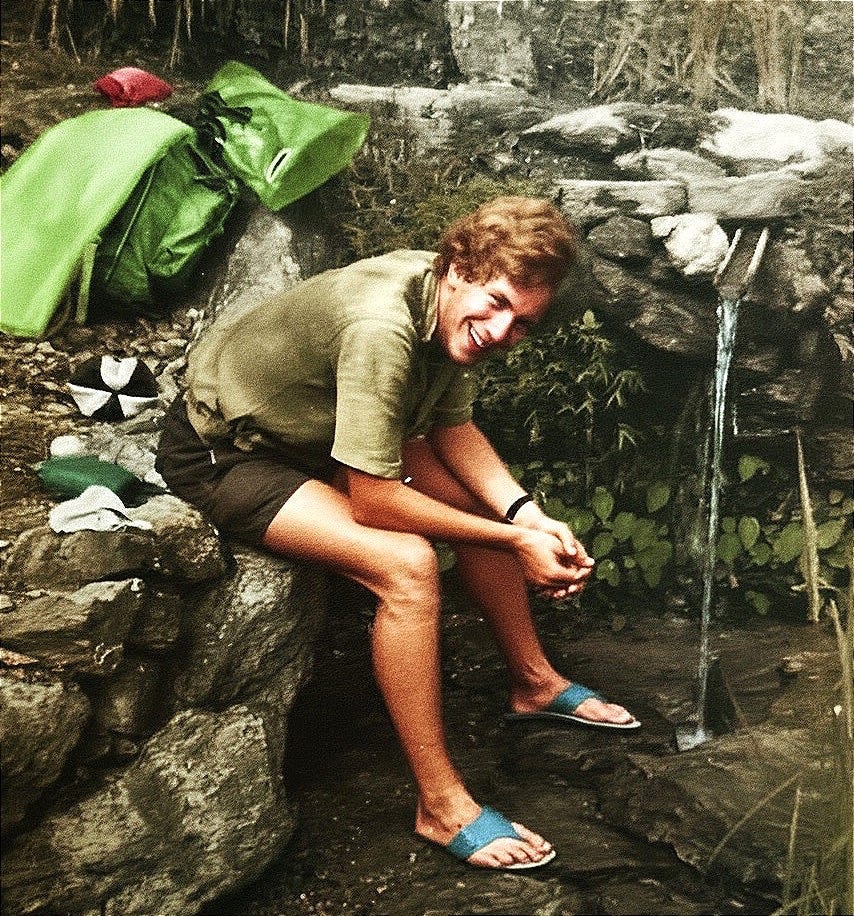
Kenneth Ing was a tall, awkward boy: ginger, precocious and loud. His father was a teacher at Buddhanilakantha boarding school in Kathmandu, and Kenneth had come to Nepal earlier that year. He brought with him the unfiltered zest of a youngster away from home and school for the first time. He’d arrived in Taplejung a couple of months before I did, spoke better Nepali than me, and seemed to know everyone in the bazãr. Yet he was starved of the company of his own tribe, and he attached himself firmly to me.
I was glad of him; my rudimentary Nepali impeded my understanding of our shared world. But I was jealous of him, too, of his language and walking skills. I was four years older than him, and in compensation I fancied myself the mature one.
Our lives had an inbuilt four-weekly rhythm—the period of viability of freeze-dried BCG vaccine once removed from a refrigerator. In the first of these four weeks, a “runner” would hike down from Taplejung into the flatlands, the Terai, where the Britain-Nepal Medical Trust (BNMT) had its headquarters. There he would pick up several boxes of vaccine from BNMT’s fridge and carry them back up again, a round-trip journey that took him six days (eight, for a fit flatlander like Kenneth). That same week, two of our Nepali team-members would scout out the next quadrant of villages and set up our vaccination schedule for the succeeding three weeks. The rest of the team enjoyed some down-time in Taplejung, in a rented group house.
Our Nepali colleagues hibernated, sleeping for much of the periods between meals. Kenneth and I lacked this adaptive faculty, so we read, talked and hiked to stave off boredom. There were few books, and we’d soon been through all of them. There was no TV in Taplejung, no screens at all and no Walkmans: just Radio Nepal, its day-long government propaganda interspersed with grating Indian pop music.
We ate a lot, stocking up for future exertions like hamsters. My diary is full of food angst.
“November 15, Friday. Today I ate 18 sel rotis [savory donuts fried in mustard oil], 10 momos [boiled dumplings], a plate of tarkaari [vegetable curry], a plate of chicken, 3 glasses of yogurt, 16 boiled sweets, 12 cups of tea. Came home to the team house in the evening, felt sick. Got drunk with Drona Bir 2. Ate some more momos. Took a Fortral [Pentazocine, an opioid]. Threw up, felt terrible. Never again!!“ And so on.
Every couple of days Kenneth and I would measure ourselves against the great Taplejung hill, running 4,000 feet down to the bridge at Doban before steaming back up again to arrive home by noon; we were young, and blessed with the arrogance that physical prowess confers on you. All the time, Kenneth would be talking, attacking me with his curiosity; fending off his questions felt like swatting bees. His mind was an unfettered millrace through which information poured, some pieces tumbling out raw, others catching and combining, much of it interrogating me—in his mind, the four years I had on him left me no alibis.
Many of his questions had no easy answers; they ranged from the profound to the idiotic. “Do you believe in Freud?” or “Don’t you think people would be a lot better for the earth if they had roots, like trees?” or “If a jackal fought a hyena, which one would win?” or “What’s it like to fuck?”
As I mentioned in What I own and what I owe (February 24, 2026), I had in fact written a guide book on this important subject at the age of 11; inaccurate as it may have been, I’d had plenty of time since to refine my scholarship. Nonetheless, the question floored me. What is it like to fuck? What did he mean—the sheer physical sensation of it? The emotions it conjures up, particularly the first time with someone: that acid hunger, the vulnerability of two naked, unfamiliar bodies?
At any rate, Kenneth’s question was quite beyond both my powers of description, and my bravery. I just shrugged, embarrassed.
I remember us sitting on a chautarã [1] half-way up the hill from Doban one morning, watching crowds of Nepali villagers carrying baskets of fruit, chickens, vegetables and ten-gallon tins of mustard oil up the trail; they were converging from surrounding villages to the weekly hãt bazãr in Taplejung.[2] This far north, the population was largely Janajati, or tribal: Limbu, Rai, Tamang, Sherpa. Women would dress in their best clothes on market day, with bright red and blue turbans, plaid blankets, velvet tunics, large beaten gold pendants hanging from their noses, oblivious to the rising heat.
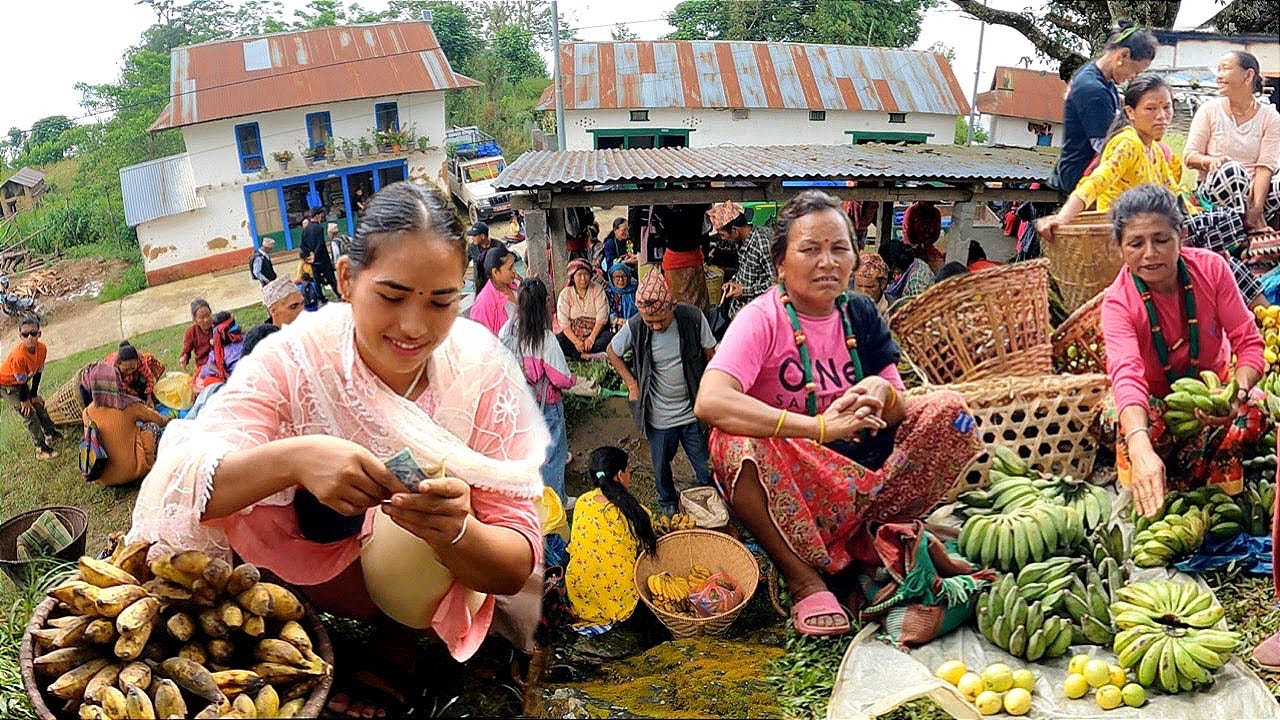
Champé Bazãr, Arun Village Municipality, Bhojpur District
“You know that Brueghel painting?” said Kenneth. “The Village Market?”
I didn’t, so he described it to me: the thatched and tiled houses around a village square filled with a swarm of peasants, able-bodied, sick, crones and children, lechers, con-men and drunkards, the dancers.
“Just like this—it’s like our medieval past. We’re so lucky to see it. It won’t last. Roads will come, and everything will be spoilt”.
“I hadn’t really thought of that,” I replied.
“I see things you don’t,” said Kenneth.
He was abrasive that way; he hadn’t learned the slippery diplomacy of adulthood.
Kenneth loved Bob Dylan; he’d memorized many of his lyrics, and he’d sing them with abandon as we walked.
I wish that for just one time
I could stand inside your shoes
And just for that one moment I could be you.
Yes, I wish that for just one time
I could stand inside your shoes
You’d know what a drag it is to see you. [3]
“Have you ever felt like that?” he asked me over his shoulder.
“Like what?”
“Like what a drag it is to be you.”
“Me? What?”
“See you, I meant.” And then, after a short pause, as if he’d alarmed himself, “Sorry, that was stupid. You must feel the same about me.”
“Just sometimes, Kenneth. And you can stop talking now, nothing’s going to collapse if you do.”
He laughed, as if he was glad someone was trying to place breakwaters around him.
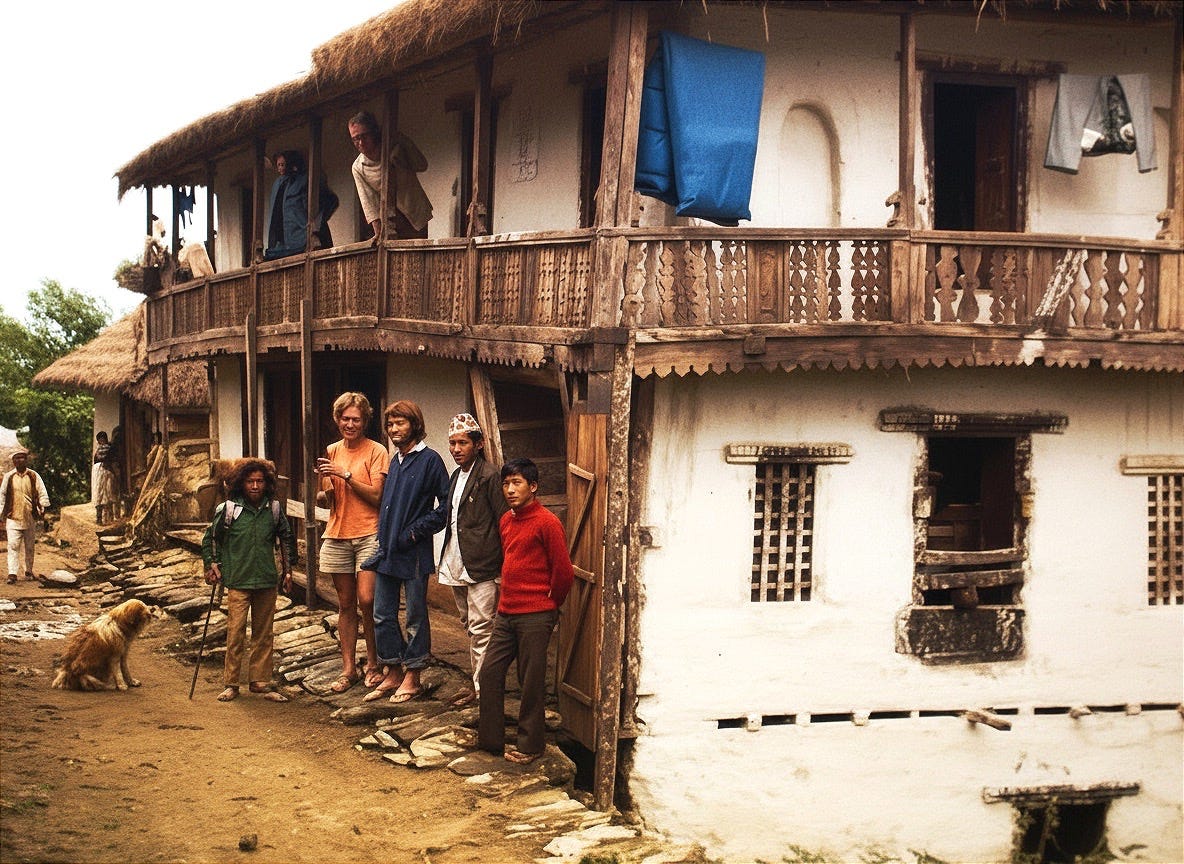
Our team house in Taplejung. L to R - upstairs: unknown, P.R. Acharya; downstairs, Buddhiman Tamang, me, Kenneth, unknown visitor, Laxman Rai.
Although much the youngest of the crew, Kenneth was a saheb; BNMT operated on unspoken neocolonial assumptions, so he’d been put in charge of the Taplejung BCG team’s accounts. Some chancer in that Nepali BCG team, though, constantly outwitted him: the accounts were always off by several hundred rupees; the food budget ran far too high; the medicine inventory bore only a passing relationship to the contents of the store-cupboard. I stepped in, four years the wiser. I was equally fooled.
Irritated by this, Kenneth and I devised a scheme to catch us a medicine culprit: the sort of thing you read about in schoolboys’ books, rarely tested in real life. The drug cupboard had always been off-limits at night; we bought a bottle of red ink in the bazaar, decanted its contents into a saucer, and placed the saucer on the angle of a half-opened door.
That night, Kenneth awoke with violent diarrhea, and rushed to the cupboard in search of some Lomotil. The ink cascaded across his naked chest. He stumbled on, down the outside staircase to the toilet, a canvas-sided wooden platform built out over the hillside. It was dark and rainy; he was in no mood to step carefully. We heard the neighbors’ pigs snorting in anticipation, and human grunting, and the splash of release—but then a splintering, a soggy thump, huge cursing. Kenneth had fallen through the platform into the shit-pit. Our previously torpid Nepali colleagues were up at once; nor would they open the door to him. He protested. They were unyielding. They passed him a large bowl of rakshi (= aquavit), plus a flashlight, and directed him to the town dhãrã.[4]
By late November, the water flowing off the hillsides into the open-air public bath was icy, headache-inducing—hence the alcohol. I trailed behind my stinking friend, carrying a towel. By the time he reached the dhãrã, Kenneth was as drunk as a lord. He threw off all his clothes and plunged into the washing pool. There was churning, loud singing, pale ginger nakedness. Wooden shutters creaked open, and fascinated faces watched this white and red-striped creature beat his chest, forego both towels and clothes, and run back up the street.
Kenneth’s effusiveness won him some unusual friends. On one of our breaks he took a trip up to Pattiwara, a Hindu pilgrimage shrine a long day’s walk north of Taplejung (I started the journey with him, but ate so many sel rotis in a teahouse along the way that I lost all ability to continue). The next evening, Kenneth returned. He’d invited a fellow pilgrim to dinner, he said; his guest was a couple of minutes behind.
“Who is he?” asked P. R. Acharya, our team leader.
“He’s a businessman. He used to be, anyway. I think he might have given it up,” said Kenneth vaguely.
A sadhu stepped into the kitchen: orange robes, rudraksha bead necklace, long grey hair coiled in a topknot, his forehead smeared with ash.
“Good evening” he said, in excellent English “My name is Govinda Mehta. Delighted to make your acquaintances.”
Like Kenneth, Govinda was a champion talker. Over rice and lentils, he shared his life story, which I recorded that evening in my diary.
Govinda was once a man of means: but his life, he was sad to admit, had become disgraceful. His father, founder of Mehta Paper Private Limited, was a thief; sorry to say this, but how else to survive in Bihar? Sometimes, one must conclude, Bihar was hell set on earth, every suffering apparent: starvation, landlordism, mafia government, child sacrifice. As if Bihar was one giant repayment centre for world’s bad karma. The family business was corrupted entirely. Bribery, racketeering, dacoity. Quint-e-ssential third world, wasn’t it? And he, Govinda Mehta, had derived too many benefits from such tomfoolery. He had realized his danger: he might be reborn as an untouchable, or some oppressed animal, or even, God forbid, a Muslim!
“Tell us how you went from there to where you are now,” said Kenneth, as if this were the most normal conversation ever.
I felt “great palpitation of the spirit”, he said. He had taken advice from many gurus. He had practiced yoga. Then one night, he had a dream. He saw himself “starkers” in a cave of icicles. He recognized the cave from photographs: it was near the waterfall of Gangotri, to the north of the great Shivaling mountain, on the river Bhagirathi, a prime tributary of “mother Ganga” [the Ganges]. Gangotri being sacred to Lord Shiva. Said Lord, on seeing that the weight of all Ganga’s water was too much heavy for the earth, placed his head beneath the waterfall like a cushion, the water flowing through his dreadlocks. When he awoke, it was clear to Govinda that he must at once become a devotee of Lord Shiva. That he must abandon his life of luxury (at least “pro-tem”)—his Ambassador car, his seat on the Bihar State Board of Cricket Control, even poor Mrs. Mehta. “Thus am I become a mendicant!” he said, laughing at the turn his life had taken.
Nodding at Kenneth, he added, “You have great heart. But you also suffer palpitation of the spirit.”
He saw something that I had noticed too, but hadn’t taken that seriously, or properly understood.
At times Kenneth’s impulsiveness and high spirits vanished, replaced by self-doubt and wretchedness, his usual energy quite gone. I had little awareness of mental illness, and thought his self-pity tiresome—an unwelcome reminder of my own, and like everything about him, unmasked.
Quite abruptly, he would refuse to get up, and his tone would turn vindictive. “You keep telling me about this novel you’re going to write, the way you see things everywhere as scenes in your book. Seems completely insane to me, living your life around some story you’ve not even written. And probably never will”.
“Almost as mad as me,” he added, as soon as he saw he had wounded me, reeling himself back in again.
II
At the end of 1974 l left the BCG team: BNMT asked me to work in their Hill Drug Scheme, and the HDS office was down at BNMT headquarters in Biratnagar. After I left Taplejung, I didn’t see much of Kenneth.
I heard from BCG staff who dropped by HQ was that he’d become increasingly moody, more edgy. I sought him out on my own work trips, but I kept missing him.
I met him again in the monsoon of 1975. He arrived in Biratnagar unannounced one night, after I’d gone to bed.
The rains were ending, and early mornings in the Terai were becoming cool and misty; I liked to get up early and take a cup of coffee out to the HDS office across the garden, before the daily hullabaloo began.
Jitan, our sweeper, was already up, swatting at the dust eddies ineffectually, smiling with reticent warmth. Jitan was a Tharu from a nearby village, an ink-black man from a tribe that had settled the malarial Terai long before the arrival of DDT, before most of the hill people who’d immigrated through Tibet could survive here. His people wore white, moved with consummate elegance and lived in compounds notable for their cleanliness, their neat grey mud houses decorated with pink palm prints, blue lizards and multi-colored peacocks.[5]
I walked into the dining room; there was Kenneth, doing vicious press-ups on the large wooden dining table. “Seventy-six” he said, smiling, carrying on. “Morning,” I said, as I bustled about, sensing craziness and not wanting to stay. “Great to see you. Got to get an order off this morning. Catch you in an hour or so?”
“Ninety-two” he said, still smiling.
By the time I came back a couple of hours later, Kenneth had already left for the hills.
Doctors are notorious for misdiagnosing themselves, and this can extend to those they work with. Looking back, the symptoms of bipolar disorder, or manic-depressive illness, should have been obvious: yet none of the Trust’s physicians seemed to notice. Certainly no-one did much to help him. Shortly after Kenneth’s departure, I went back to Hong Kong to raise funds for HDS. And while I was away, Kenneth disappeared.
At first, nobody was too worried: he’d been on his way up to Dhankuta district, where BNMT had a clinic, and he was going from there to a Terai district where he was starting up a new BCG campaign. He was carrying a large amount of cash with him, but there was nothing abnormal about that. Several days later, though, after he’d failed to turn up in Dhankuta, the police were alerted. Eye-witness accounts begun to come in. He’d left BNMT for the bus station in a wild mood: “Yes, he was pretty odd that morning, you know, mad laughter, but that’s him, isn’t it? I mean, that’s Kenneth.”
One report placed him in Dharan that evening, a town at the margins of the Terai where the paved roads ended and the climbing began. Someone said he’d been arguing with a group of young Nepalis. It was definitely Kenneth, from the description: he was unmissable with that red hair of his. He was wearing white cotton trousers and a flowing white shirt, wooden beads, like an albino sadhu, they said. No-one had seen him after that.
Days passed. The police searched the forests around Dharan. There was talk of Indian dacoits, who still roamed the unmarked border with Bihar. Kenneth’s parents were notified. I was told that his father greeted the news of Kenneth’s disappearance with a strange coldness. “If he’s lost, he’ll show up. If he’s dead, it’ll be difficult for me to come down, so please do whatever’s needed; don’t wait for me”.
There is something amiss here: no child is that disposable. Perhaps it was an ill-judged attempt to show stoicism, magnified in the telling; I suspect he knew that his son was dead.
In the end, some villagers out collecting wood found a body in the forest a couple of miles from Dharan bazaar. The police called BNMT, and Frank Guthrie, Kenneth’s boss, went there with BNMT’s director and one of the doctors, Nigel Padfield.
The corpse was hanging in a large tree, one leg wrapped around a branch, the other eaten away by some wild animal. The days were warm, and he’d been there some time; it was the smell that the wood-cutters had first noticed. He was blackened and bloated, but it was Kenneth: there was no mistaking the hair.
Had he killed himself, or had he been murdered? The police believed it was murder. A year earlier, a Gurkha pensioner bringing a cash payment home from the British Gurkha camp in Dharan had got drunk in a teashop, and told someone he was carrying money. His body was later found in a cloud forest up in Terathum district, strung up from a tree, with pills scattered at his feet. The killers had betrayed themselves by overspending in Terathum bazaar, and had later confessed.
Here too there was a noose, and there were pills, later identified as Phenobarbital, and the cash was gone. But there was one detail the police paid no attention to: the rope around Kenneth’s neck had been plaited intricately, unnecessarily, the sort of obsessive thing Kenneth would sometimes do. Yes, there’d been some argument in Dharan—Kenneth could be belligerent when he was depressed. But murder?
I can see him planning this, taking himself into the forest, climbing the tree, putting the noose around his neck, swallowing some of the tablets he’d brought. Had he really intended to go through with it, though? Perhaps he had; but I wonder if he’d changed his mind once he’d pitched off the branch, or if he’d slipped, befuddled, and found he couldn’t climb back up again.
Maybe I am wrong; I may be influenced by what I heard about my own daughter’s death. She’d been drinking; she may have been flirting with the notion of suicide when she fell over that balcony.
Perhaps their impaired judgment took them to places they never really intended to go; perhaps not.
When I think of Kenneth now, I think of a life of promise laid waste, leaving questions, blank spaces and residues of pain. This is what happens when young men and women die in war, in accidents, or from untimely illnesses.
You can picture those blank spaces this way. An elderly lady is sitting down to a family Christmas dinner somewhere in Britain; this is the woman Kenneth would have married, but who never knew him. She is sitting with her husband, their two children, their spouses and several grandchildren. But Kenneth is missing; his bloodline has vanished, and none of them is even aware of it.
Notes
[1] A typical chautarã is a stone platform, built by local villagers for travelers to rest on, often featuring a peepul and a banyan tree planted on either side to give shade. Chautarã were a regular feature on the main walking trails of the middle hills of Nepal before the advent of motor roads, and the eclipse of walking by jeeps and buses.
[2] A hãt bazãr is a periodic market, one that takes place on a regular basis. The days of the week on which certain markets are held have, in some cases, given rise to the village’s name: thus Mangalbaré derives from mangalbãr (Tuesday), and Budhibaré from budhibãr (Wednesday). Other towns are named for the day of the Hindu lunar calendar on which their market is held; for example, Panchami (the 5th lunar day) and Saptami (the 7th lunar day).
[3] Lyrics from Positively Fourth Street, 1965, Copyright © 1965 by Warner Bros. Inc.; renewed 1993 by Special Rider Music.
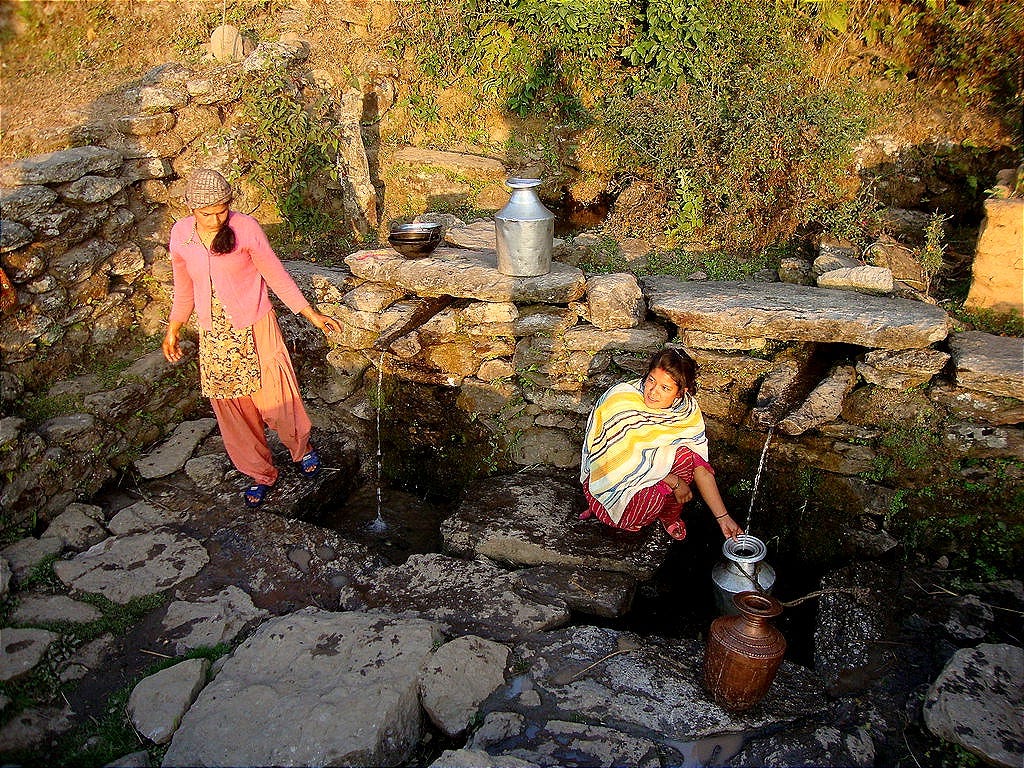
[4] Public dhãrã [= tap] could be found in many towns and villages, constituting the main source of water for washing and drinking before the advent of modern water supply schemes. They would often channel water from the forests above the settlement, through channels into a bathing area, arriving in elaborately carved stone or brass spouts representing nãgã, the mythical guardian serpents that inhabited the lake covering the Kathmandu valley in the days before mankind (image from Ramechap District on flickr.com, https://www.flickr.com/photos/50795948@N05/8909459467/).
[5] Jitan was a TB patient whom the clinic staff had given a job; his wife was our laundress. He seemed unable to maintain his daily doses of TB medication; it was a common problem for villagers not used to such routines. He had already lapsed twice, and would die within a couple of years.
Photo Credits
Eastern Nepal Village Market; video 112, Nepal Country Village Life series, by Bijaya Limbu, 2025.
Thanks for reading my Substack. Please feel free to subscribe - and there’s no need to pay!