
KP Bhattarai
Billy Bragg meets the ex-PM

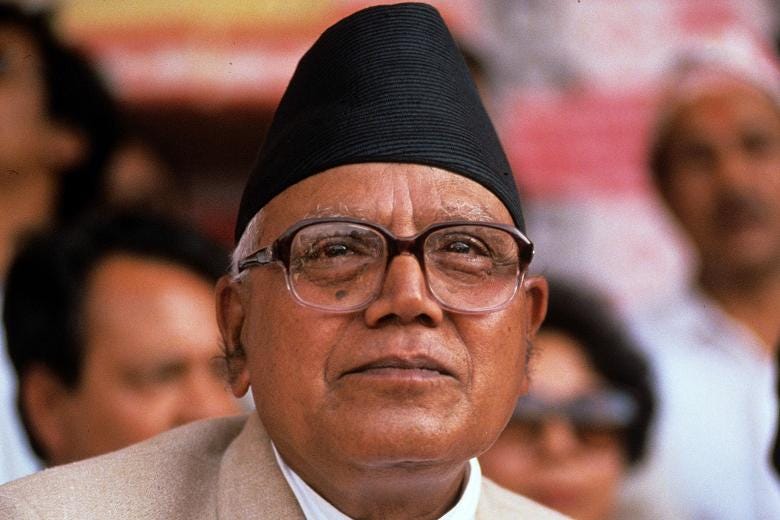
I spent 1987-1992 in Nepal working for the World Bank. The signal event in those times was the 1990 Jana Andalan, the People’s Movement; this ended 30 years of royal autocracy (under the Panchayat system of ‘guided democracy’), and ushered in a period of constitutional monarchy. In 1993 I returned to interview key Jana Andalan activists.
My favorite memory from that visit is a dinner with Krishna Prasad Bhattarai, Nepal’s first post-Panchayat Prime Minister.
In The Nepal Scene, Liz Hawley offers the kind of CV I wish I had read more of in my professional life—short, meaningful, no list of obscure journal articles:
He was born in December 1924 when his parents were living in exile in India, received a bachelor’s degree in economics from Benares Hindu University, was associated with the Indian National Congress’ Quit India Campaign in 1942, commanded Nepalese revolutionary forces in the eastern hills in 1950 and became speaker of the first advisory assembly after the revolution in 1951. He was speaker of the lower house in 1959-60, was imprisoned when King Mahendra seized direct power in December 1960, and spent 14 years in jail. He has been acting president of his party since 1977. He is a bachelor, a man of simple habits who, when not in jail, lived in a sparsely-furnished room in his nephew’s modest house in the Pulchowk area of Patan and never owned a car. When he reluctantly moved into the large official residence of Nepal’s prime minters in Baluwatar 11 days after having taken office, the possessions he took with him were reportedly his roll of bedding, his umbrella, an earthen jug, a tin trunk and some books.
This was the man who sat cross-legged on a Tibetan carpet in another modest room, this one in his sister’s house, on a stormy monsoon night in 1993. In those days, load shedding was common; the lights were out and a single candle burned on the concrete windowsill.
“Let us have a drink” he said, and took a bottle of Johnny Walker (Red Label) out of a cupboard. “Shall I add water?”
After a year as Prime Minister of the Interim Government, he unexpectedly lost his Kathmandu seat in the 1991 elections, and was replaced as PM by the general secretary of the Congress party, GP Koirala—this despite a poll taken three months earlier suggesting he was by far the most popular politician in the Valley. During his premiership he oversaw the promulgation of a new democratic constitution, and the renewal with India of the lapsed trade and transit treaties. We had met a number of times during that year.
The man who defeated him in 1991, Madan Bhandari, was the charismatic General Secretary of the United Marxist-Leninist Party; UML had won 8 of the 10 constituencies in the Valley. Bhandari had just been killed in a car crash, and Bhattarai was planning to contest the now-vacant seat (he would lose that January 1994 by-election to Bhandari’s widow).
After a couple of whiskies, KP and I went to my car; I noticed he was a bit unsteady on his feet and took his arm. Thunder was banging away around the edges of the Valley.
“My eyesight is fading” he said. “In July I am going to the USA. For three operations on two eyes”.
My driver took us to the Summit Hotel; I had booked a guest room for dinner, since we could otherwise expect to be besieged by well-wishers and supplicants.
He chuckled as a super-respectful attendant showed us into the room. “Eighty-five US dollars per night” he said, reading the tariff sheet on the back of the door.
There was fussing and gesturing, the lights failing and coming back on again. Eventually we were alone, a glass-topped table between us laden with cheese pakora, chapati, sizzling chicken, rice and dal. And another bottle of Johnny Walker.
Vicious lightning outside, and a cacophany of thunder.
KP picked the bottle up. “I believe” he said, looking at a breezy Johnny striding across the bottle, “that he has just fallen off his horse. But he is concealing it well. A politician he must be”.
KP and the current prime minister were not the best of friends, and their feud had been aired out in public over many months.
“Our respected leader GP Koirala was not in favor of the People’s Movement, dear Nigel. Did you know this?”
No, I did not.
“There have always been two types of people in Congress—both good Congress people no doubt. The one believed in accommodation with the King and his Panchayat system. The other did not”.
“And” he added, rather mischievously, “There are two kinds of people as well, my dear. There are those bloody fools who cannot see that everyone else does not believe what is so clear to them. I am in that category!”
The whisky was taking its toll on me, too.
“I am confusing you. I mean the Panchayat system was so obviously finished, so despotic—this was so clear. To what could one accommodate? The Panchayat couldn’t even straighten one single bloody road in 30 years. Even the King could see this. Unlike some others I shall not name. Cheers! This is so pleasant. Normally I am out chasing girls at this time of night!
“The first time the King met me—you remember, that day….three years ago? Is it three already? Goodness. The day of shootings outside the Palace. He said ‘Nepaliko ragat bagauna thik chaina’ [it’s wrong that Nepali blood is being shed]. The King was a smart enough fellow. He knew his time had passed. You British had trained him well”.
He sat back, laughing. His teeth were bad, his mouth red with the betel nut he habitually chewed. The lights went out again; thunder boomed. From the next room, suddenly and very loud, Billy Bragg was singing Sexuality—from the Don’t Try This at Home album.
Stop playing with yourselves/In hard currency hotels/I look like Robert de Niro/I drive a Mitsubishi Zero/Sexuality, strong and warm and wild and free….
“How old are you, Nigel” he asked. I said I was 42. “So young!” I said if I could achieve a half of what he had with the rest of my life, I’d be satisfied.
He laughed again, stood up abruptly and made for the toilet. To my alarm, he selected a large corner wardrobe, stepped through its doors and tried to close them behind him.
There was a puzzled thrashing of coat-hangars before he re-emerged, looking startled, and the lights went out again. I could hear him fumbling his way along the wall and into the bathroom.
The lights came back, and so did Billy Bragg.
Sexuality….come eat and drink and sleep with me….”
Eventually KP emerged, and sat down again.
“Ah yes…….Just do something good for other people, Nigel. I have been true to myself, I think. Mostly. I have anyway tried, though I am just an old fool really. There is no difference between you and I. God is in both of us, and we are alll fools. Christian, Hindu, this isn’t important”.
I may have been drunk and disoriented, but nothing was clearer to me than the difference between myself and this man.
“What of those 14 years in prison? Didn’t you despair?”
“Despair? It is best I tell you in Nepali. No—I will write to you about this. I was locked up many times. The British started it. I was glad, it helped me grow strong. The prison walls were like—like a backbone for me. Do you understand?”
The serving boy came in with ice-cream: a foul pink concoction that we would both avoid. For the second time, KP asked his name.
“Basanta Tiwari” he repeated.
“Yes, yes. Where is your home?”
Waling, in Syangja District. Thirteen years ago, the boy said, you stayed the night in my father’s cloth shop.
“I did? That is wonderful. And look at you now!”
I was fading, but the thunder seemed to reanimate him. He talked about BP Koirala, GP’s older brother who had led the democracy movement in the 1950s and was Prime Minister before the Royal Coup of 1960. “I had always said the movement should be conducted from within Nepal. BP was in Banaras after they released him from jail. When he came back to Nepal in 1977, I was able to organize 500 people to see him—the 500 that he needed to know. In fact all were arrested, myself included, and at 6 am, so we all missed our breakfast. And that particular meeting, though it is the breakfast I most regret. I had told him—those outside should give up or come home. It is here we will win. We didn’t, of course, for a very long time. And now we have!
“There are two types of people in Nepali Congress, Nigel. From the very beginning. Even the great BP wanted to collaborate with the King. The other type wants solely to work for the people. BP was arrested that day too, but after three months he was free to leave his house. This was only because the Janata alliance and Moraji Desai came to power in India. After the referendum in Nepal, BP wanted Congress to run in the next general election. I told him no. I said, so you win 30 or 40 seats. Who wants that? In the end he agreed with me”.
KP was confirming to me the central dilemma that Congress faced in its years in the wilderness—the extent to which it should accommodate itself to the reality of Palace power, and what that accommodation would do to its identity.
“You must understand what change means here” he then said. “How long it takes people to accept a new idea. To believe they have political rights. I have known people who have never seen a bicycle. They cannot distinguish between a bicycle and an aeroplane! Some hill people have even travelled in an aeroplane before they have seen a bicycle. This is psychological impediment to our development—it has come too quickly. That is why some people do not understand their own good interest”.
And yet they supported the People’s Movement, I said.
“Yes. They had no difficulty with that. It was a moral matter”.
I had just picked up some large color photographs of the huge crowds that had gathered in Ratna Park on April 6th 1990, from the photographer Min Bajracharya. I showed them to him.
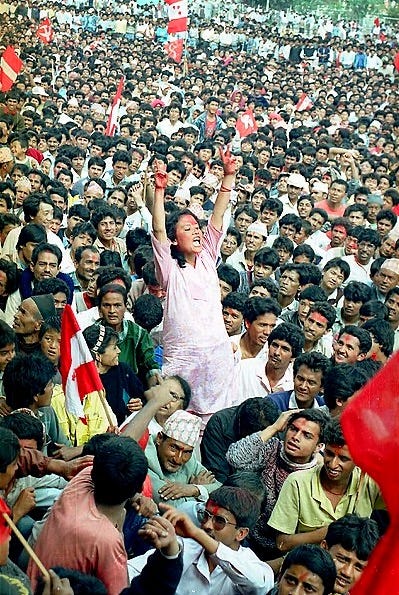
He peered at them through fading eyes.
“Yes……they are very good. But no-one has managed to capture the reality of this Movement. How could they? How could they set down the grief of the bereaved, the joy of victory? It is impossible. Perhaps if we had our Dickens, or our Tolstoy. Perhaps then".
And this is what stays with me all these years later. His tired, quizzical face. His mischevous laugh. The way he wore his own undeniable commitment so lightly—a habit that often drove his own comrades to distraction.
And I also remember the outburst of affection I felt for him in that thunderous, echoing room.
Photograph of K P Bhattarai from his Obituary in The Times, March 11, 2011. The Obit is worth reading: see https://www.thetimes.com/article/krishna-prasad-bhattarai-bs0xfb2h6p7
The Nepal Scene: Chronicles of Elizabeth Hawley - 1988-2007 (Two Volumes), 2015, Lisa Choegyal and Mikel Dunham, Kathmanu, Vajra Books
Photograph of student Durga Thapa in Asan, Kathmandu, April 9th 1990, taken by Min Ratna Bajracharya - from Wikimedia Commons
What an absolutely extraordinary meeting, Nigel. With an extraordinary man.
You don't say quite what you were doing there that night but it makes thrilling reading.
Such heady potential in 1990 and today…..?!