
Sir Jamsetjee
"For evere the latter ende of joye is wo/God woot that worldly joye is soone ago." Geoffrey Chaucer, The Nun’s Priest’s Tale

Chloe Dalton’s 2026 Raising Hare: A Memoir describes her relationship with a wild hare, beginning when she found an abandoned leveret near her home in the English countryside Hares, I learned, can’t be tamed. The beauty of this book is in the way that Dalton, against the grain of a busy life as a policy adviser, came to respect and love a creature she would otherwise have seen the way the rest of us do—as a passing flash across a farmer’s field. Her dormant powers of observation were awoken, and with them an intensified sense of connection with the natural world around her.
The book has won several prizes, with thousands of readers drawn to her elegantly written story. The title and the cover might lead you to think this is another best-seller about the way pets can enrich our lives: like Syou Ishida’s We’ll Prescribe You a Cat, or W. Bruce Cameron’s A Dog’s Purpose, where the animal in question ‘teaches’ us how to be better people. But Dalton’s book is about the wildness of the hare: more in the tradition of Gavin Maxwell’s 1960 Ring of Bright Water (otters, in his case), Helen Macdonald’s 2014 H Is for Hawk (a goshawk, in hers), and the 2020 Netflix documentary My Octopus Teacher. In each instance, a wild animal changes the writer by its very differences, and by the unusual effort needed to appreciate its world; an effort that requires the observer to set aside his or her ego.
Peter Matthiessen’s 1978 classic, The Snow Leopard, is both counterpoint to and exemplar of the same experience. Matthiessen’s journey to Dolpo was an attempt to constrain his ego by absorbtion in both Zen Buddhism and nature—an attempt largely undermined by his restless self-consciousness. Whether he intended it or not, this contrasts with his portrait of his companion, the wildlife biologist George Schaller. Schaller had a practical reason and a professional obligation in undertaking the journey: to observe the Himalayan Blue Sheep in mating season, and thereby shed light on whether this mysterious, little-studied creature was sheep or goat. If you read his 1980 Stones of Silence, you will find an immanence that is missing from Matthiessen’s experience—perhaps because Schaller wasn’t explicitly seeking it. At one point he writes of an encounter in the Hindu Kush, seeming almost to become one with the animal he is so intently studying:
“Then the snow fell more thickly, and, dreamlike, the cat slipped away as is if she had never been . . . the snow leopard represented not just a rare and beautiful cat whose habits I wanted to study, but also the symbol of a search for something intangible that seemed forever elusive.”
What also struck me about Chloe Dalton’s book was our habitual barbarity towards creatures like the hare. Apart from the lazy misunderstandings that led to stock phrases like ‘harebrained’ and ‘mad as a March hare’, much of our contact with hares has been cold-hearted and brutal, be it as hunters or farmers:
“It is the hare’s sad fate that its speed is also its down-fall, since it makes it attractive to human hunters. From the mountains of Greece to the deserts of Egypt and the valleys of Britain, humans have hunted hares since antiquity: on foot, on horseback, with falcons and hawks, with packs of hounds, beagles and bassets, with rifles and shotguns or cruel wire snares placed across their runs to trap and strangle them . . . In his short story “Little Warhorse,” Ernest Thompson Seton describes “rabbit drives” in early twentieth-century America . . . Seton writes that in one hunt, a “surging mass of over four thousand [hares] were ruthlessly given to slaughter,” while five hundred of the strongest specimens were taken alive to be kept in pens for the purposes of coursing—the setting of pairs of greyhounds against hares . . . Photos from hare hunts of the era show acres of ground carpeted in a solid mass of dead hares, and corpses strung about fences as trophies. In Britain, coursing was designed to test the mettle of prized hunting dogs . . . Hundreds of thousands of hares are still shot each year in Britain for recreation, and millions in Europe as a whole, with customers often paying large sums for the pleasure.”
After the combine-harvesters have been through the fields bordering her house, she finds dead and injured hares, chopped up in their passage.
“I stood at the edge of the fourteen-acre field and wondered with a sinking heart how many other leverets, or indeed ground-nesting birds, had been crushed beneath those implacable wheels and now lay within the ridges or lost to sight against the rutted brown earth. It was just another day, just another harvest, a scene replicated up and down the land and across the world.“
Dalton’s book explores a compartmentalization fundamental to human society: we love, or at least cherish, those who are close to us, both human and animal, but our empathy decays sharply with distance. Witness, for example, the outpouring of American grief and outrage at the murders of Charlie Kirk and Rebecca Good—and our collective indifference to the massacres of Sudan’s distant civil war, where up to 400,000 people have died and perhaps 15 million have been displaced since the war began in 2023.[1] They aren’t our people, after all. They are nothing to us.
This dualism, and our associated capacity for cruelty, is particularly stark when it comes to chickens.
I’d never thought much about chickens until my wife Sarah and I began raising them. In the Spring of 2023, on impulse, Sarah ordered some chicks. She picked them up, as you can, at our local post office.[2] When we got home, the open carboard box revealed ten startled yellow Lavender Orpingtons, and one black interloper. This one had been thrown in for free, and turned out to be a rooster—a Chocolate Brown Orpington.
This was our first and wisest purchase: other chickens have been bought from local stores or hatched from our own eggs, methods guaranteed to distort the appropriate rooster-hen balance (ideally, 1 to 8 or more).[3] By the Spring of this year we had 32 chickens, with 18 roosters to 14 hens. We are unable to give our roosters away—they are unnecessary for egg production, and in most urban and peri-urban areas are banned because they make a lot of noise (a human prerogative). We are also unwilling to slaughter them, a delicacy that has resulted in gang rape and severe feather loss to our harried hens, which we mitigate only somewhat by protecting them with ‘hen saddles’. Early summer brought a clever fox, who has helped himself to eight chickens, six of them roosters. With a new draft of better-sexed imports, the ratio is a little healthier now: 12 roosters, 35 hens.
Chickens, I once thought, are easily scared and rather stupid. From owning and watching them, I have been reminded not to confuse brain size with character. Modern chickens are a human confection, bred from wild ancestors like cats and dogs were: but unlike house pets, they are not ‘tame’ and do not ‘bond’ with people in the same codependent manner; they remain half-wild, their own society of far greater importance to them than any association with us—and yet we can recognize in them many of our own human characteristics. None of the authors I have mentioned avoid anthropomorphizing animals: i.e. ascribing to them various human characteristics that they find, on the whole, admirable. Human behaviors constitute our essential frame of reference and judgment—and we ourselves are animals. In his 1871 The Descent of Man, Charles Darwin wrote
“The following proposition seems to me in a high degree probable—namely, that any animal whatever, endowed with well-marked social instincts, the parental and filial affections being here included, would inevitably acquire a moral sense or conscience, as soon as its intellectual powers had become as well, or nearly as well developed, as in man. For, firstly, the social instincts lead an animal to take pleasure in the society of its fellows, to feel a certain amount of sympathy with them, and to perform various services for them.” [4]
The characters of our chickens vary from bird to bird around certain common traits: excitability, moodiness, loyalty, territoriality, affection, fear. Dominant roosters are invariably aggressive towards other roosters, but there is often an easy companionship between ‘Beta’ roosters, and all are protective of the flock as a whole: they call to one another across the garden throughout the day, particularly if there are predators nearby. When given time to react, roosters will place themselves between a fox and the hens, however futile the effort (hence the lopsided casualty ratios). Chickens that grow up together remain bonded throughout their lives: one touching example of this is the inseparability of a tiny Silkie hen and a large Americauna rooster. Both were incubated from eggs we collected, then raised by a mother with her own single chick, which died. Whenever the Silkie either sits on a clutch of eggs or falls sick, the Americauna stays in the coop with her until she is ready to come out again.
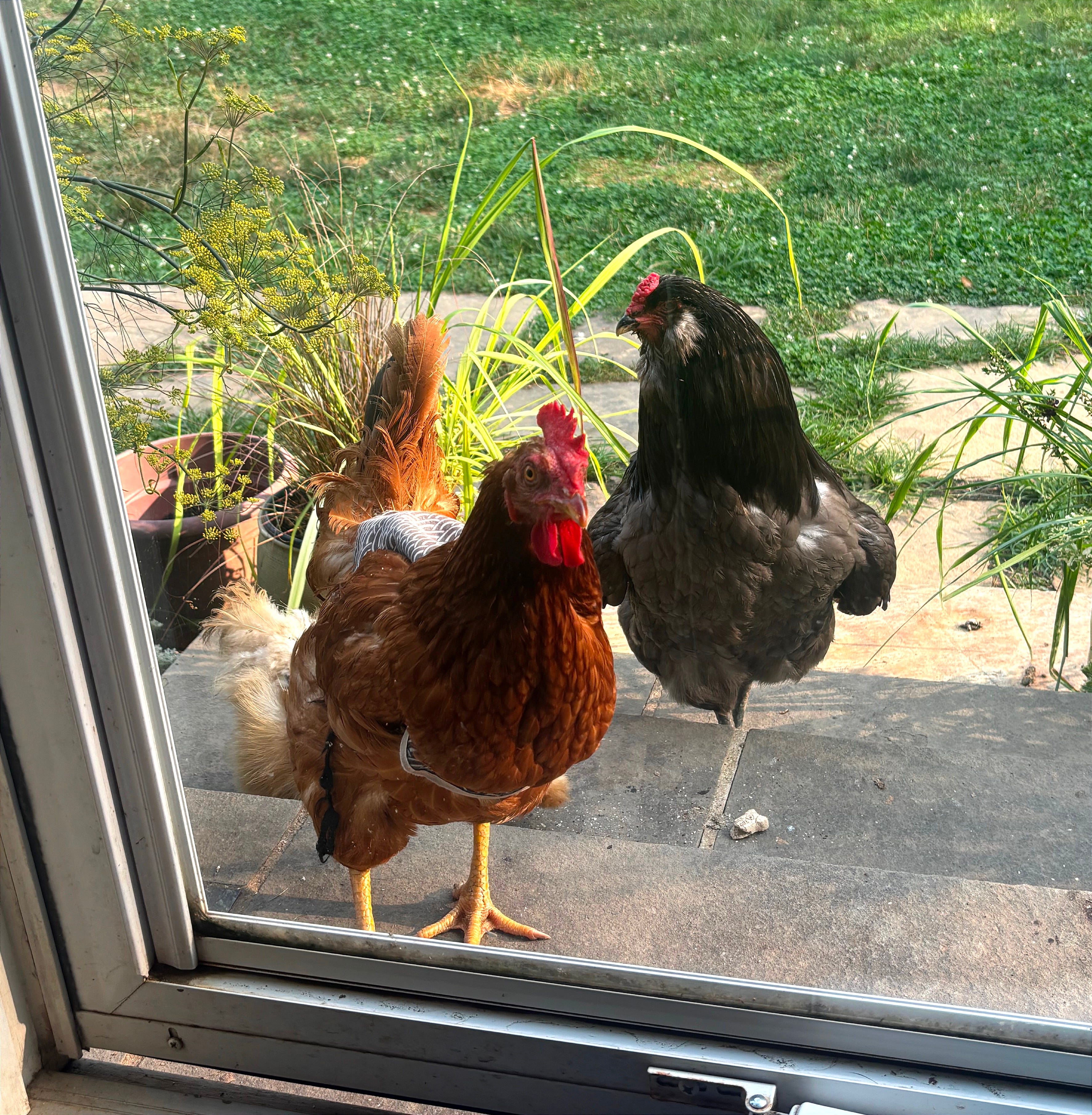
Our chickens are also curious about us. It is common to find a gaggle of them staring at us through our glass kitchen door, as if the house is a zoo and they the patrons.
For two years, our original Chocolate Orpington was the Alpha, the boss of the barnyard. As such, he kept the rising generation of roosters well off ‘his’ ten hens. Several of these adolescents (Boris, Little Head, Sir Garnett Wolsey) would trail him and his flock, sneaking a bit of sex when he was distracted (possible in chickenworld, where the act takes only seconds), living in his considerable shadow, and in some cases, sustaining this deferential behavior into full adulthood—like incels, minus the compensations of screen life.
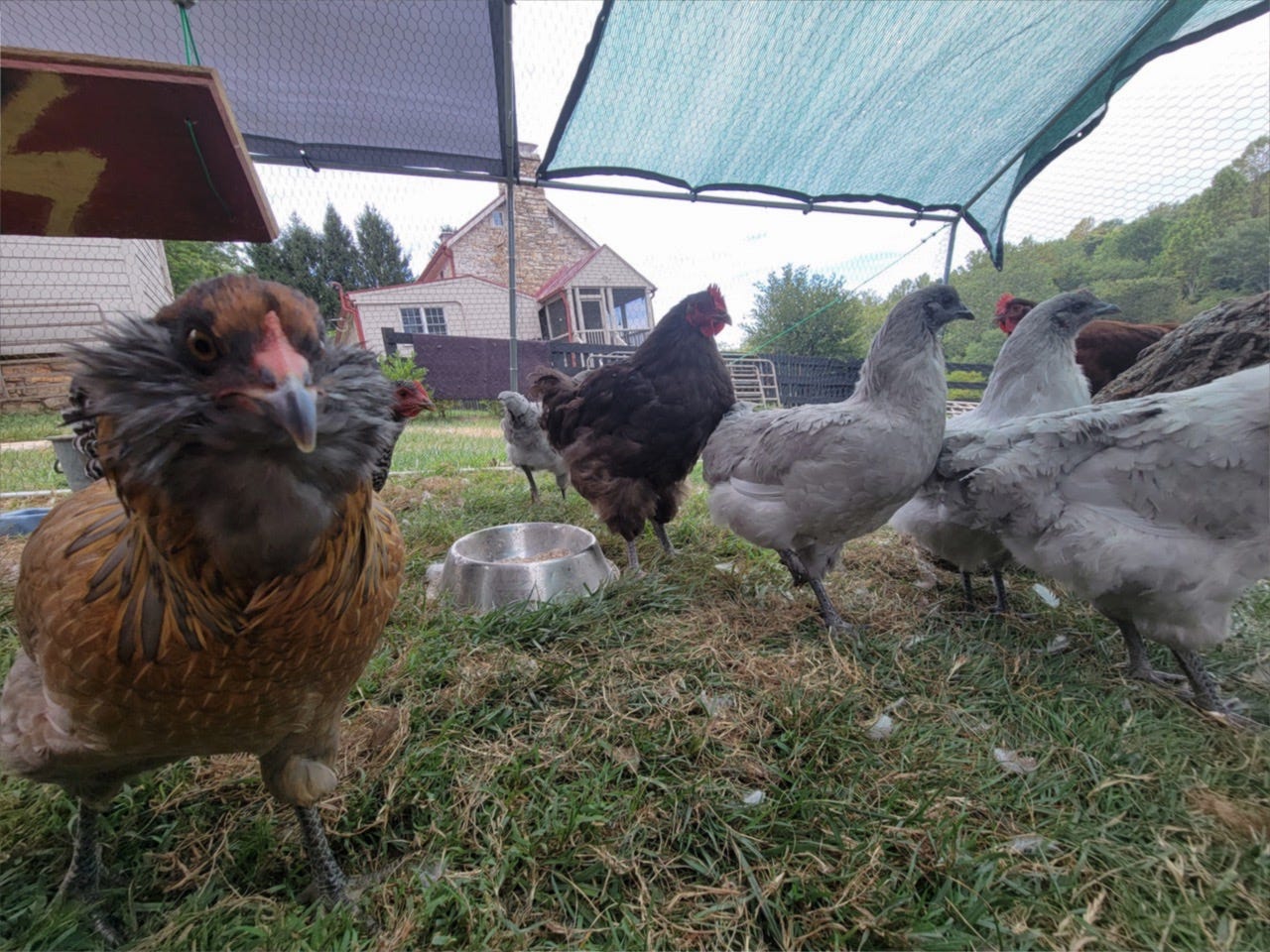
Miss Americauna, and a young Jamsetjee with the four original Lavender Orpingtons: Doris, Mabel, Ivy and Hilda
Geoffrey Chaucer was a chicken fancier, as even the most cursory reading of the Nun’s Priest’s Tale reveals. This description of Chauntecleer fitted our Chocolate Orpington perfectly except for his color (gleamynge chasteyene, in his case).
"His comb was redder than the fyn coral,
And battailed, as it were a castel wal.
His byle was blak, and as the jeet it shoon,
Lyk asure were hise legges and his toon,
His nayles whiter than the lylye flour,
And lyk the burned gold was his colour."
And just like Chauntecleer, this hypersexed yet considerate creature would cluck in a low register to his hens whenever he found something to eat, picking the grains up and dropping them, and only eating after they had:
“He chukketh whan he hath a corn yfounde,
And to hym rennen thanne hise wyves alle.“[5]
Whenever one of his hens laid an egg, she would shriek in self-congratulation, and he would join the other hens in announcing this latest triumph to the whole valley.
However: when it came to me, or to other human males, he was as mean a bastard as you could conceive of—however much I fed him, talked to him, told him I was protecting him. Seeing me from the other side of the garden, he would stalk me, coming quietly up behind me and launching himself at my back, karate-kicking me with his impressive raptor-like claws; should I get wind of him and turn around, though, he would stop, turn sideways-on and stand stock-still, as if he hadn’t even noticed me. At other times he would just charge at me full-bore, like a rugby wing-forward, aiming for my balls. More than once he flattened me.
The best way to repel him was to put my foot out and let him expend his energy against the sole of my shoe: this might involve a dozen attacks before he grew tired and let me go. The journey from the house to my office was like crossing no-man’s land under fire. I finally invested in an electric water pistol, and discharged the whole magazine at him one morning. He turned sideways, as if in disdain, absorbing everything, shaking the spray away—and then attacked me again. There was something heroic about this heedless combination of anger, resolve and bloody-mindedness, qualities displayed by heroes as diverse as Joan of Arc, General Gordon, Moby Dick and Nelson Mandela.
Unlike Chloe Dalton, who refused to name her hare lest this delude her into thinking she was taming it, we called this maleficent creature Sir Jamsetjee Jeejeebhoy. I had been reading William Dalrymple’s The Anarchy, a tear-down of the British East India Company that dissolved any lingering illusions I possessed about the impulses behind Britain’s colonization of India. Something about the rooster’s self-esteem and cunning spoke to me of the grandees of those days of High Colonialism.[6]
In late 2025, though, Sir Jamsetjee met his comeuppance: not from me, but from a combination of disease and those he had himself sired. Suddenly his larger Orpington/Barred Rock son, Niké (named for a white swoosh on his right wing) displaced him. All his hens deserted him. The incel chorus forsook him, forming a new court around Niké. Worse, Sir Jamsetjee was assaulted nightly on his perch, and his tail was torn out. Our first intimation of all of this was seeing him alone one day, defeathered.
Had this persisted much longer, we knew, he would have been pecked to death. So we brought him inside to protect him; he didn’t resist or complain, let alone attack me. His comb was dull now, and had shrunk: a sign of his diminished status. He no longer crowed.
Thus he began a second life as a house chicken. In the daytime he would walk stiffly up to my office, waiting to be let in, and would sit beneath my desk and sleep. In the evenings he sat next to us on the sofa, watching TV. At night he slept inside in a box, and like many old men, wore a diaper. At 74, I found it easy enough to identify with a cockerel who’d lost his luster, and whose careless treatment of competitors had come back to haunt him. Sarah saw in this strange reversal of our relationship a transition from the piss and vinegar of youth to a mellowing of male aggressions, complete with that vacancy that can pass off as reflection, or even quiet wisdom.
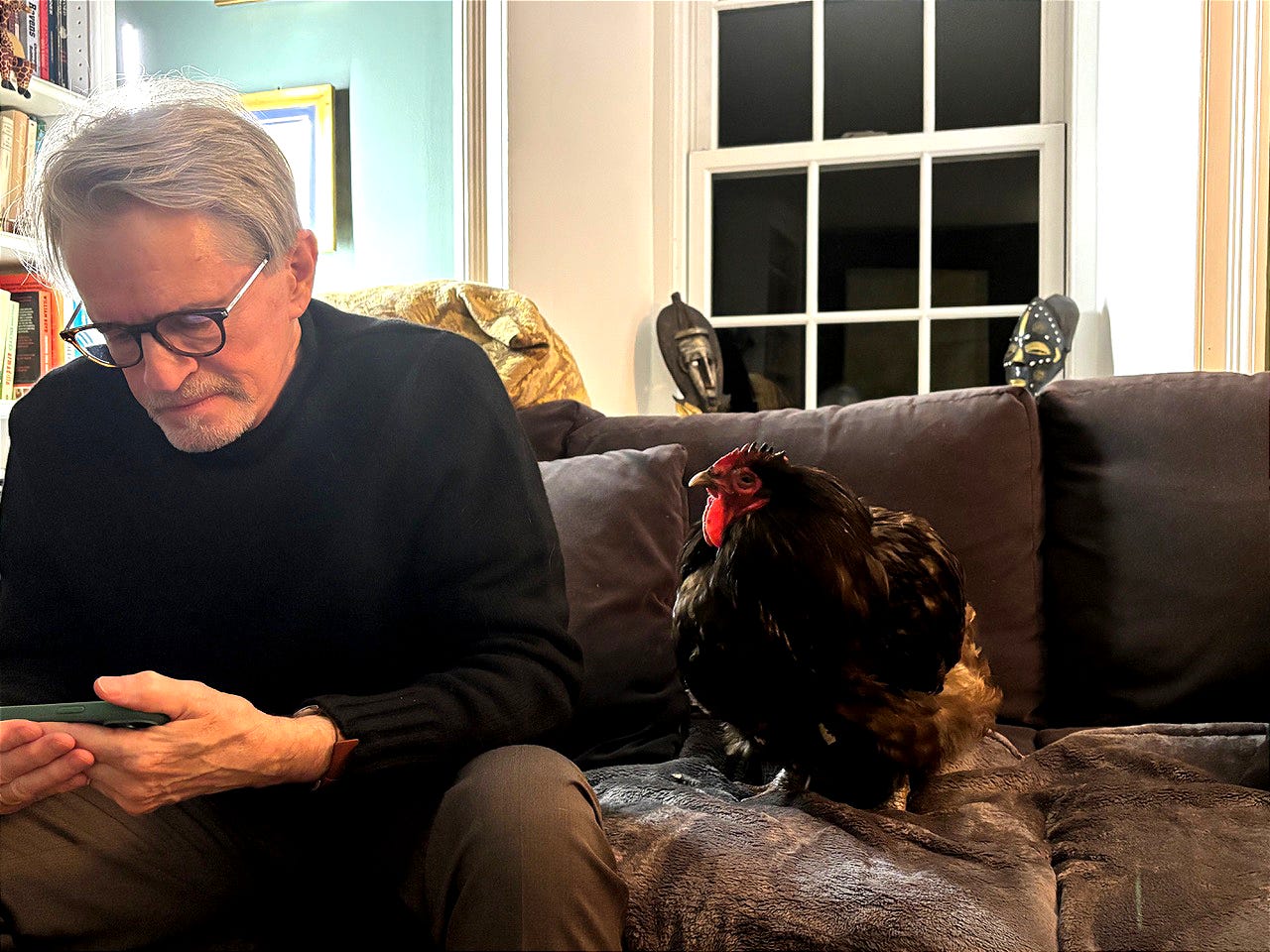
Me and Jee playing sudoku
The truth was more mundane: Sir Jamsetjee was suffering from cancer. This was the weakness that his fellow chickens had detected long before we did, and which caused them to abandon him for a new protector. He died about three months after his rejection by the flock. Sarah buried him in the flowerbed, under his favorite wild flower garden, too deep for any dog, coyote or fox to dig him up.
And yet.
For all of the delight and admiration we feel for these fleeting inhabitants of our land, we still eat chicken. Not our chickens, mind: other anonymous chickens slaughtered for us by people we don’t know, and presented to us in unrecognizable form, as breasts, thighs, cutlets; as rotisserized carcasses; as processed nuggets. We eat chicken in volume, without any qualms. They aren’t our chickens, after all. They are nothing to us.
Ian Frazier’s February 2026 essay for the New York Review of Books, Bang the Drumstick Slowly, details the vast increase in global chicken consumption since the end of World War II, driven by fast food outlets like MacDonalds and KFC:
“Chickens are now the most populous terrestrial vertebrate. At any one time, about 26 billion chickens occupy the planet, as 65 billion are slaughtered annually and billions more hatch. The next most populous bird, the house sparrow, numbers a mere 1.6 billion. According to a study of the biomass distribution on Earth, chickens and other poultry comprise 70 percent of all birds by weight.“ [7]
It isn’t just the numbers: it’s the profligacy and heartlessness of this global industry that is so striking, and so quintessentially human.
“Behind the [few] lucky backyard chickens lurks the horrible fate of almost all the other chickens on Earth, who live in a Dantean hellscape, if one can imagine the Inferno’s tortured souls as somehow also eventually turning into something delicious to eat. But even in that scenario, a certain number of commercial chickens are truly lost, because the US throws out 30 to 40 percent of all the food it produces [8] . . . Not long ago I was driving on a frantic four-lane road in eastern Arkansas when a chicken truck passed me. By the look of the cargo, it was carrying broiler hens from the mass prison where they’d been raised to the factory where they would be slaughtered. They were in wire cages stacked one on top of the other. The birds looked like individually sorted white feather hats on their way to the bargain basement. Their cages were designed to be too small to allow them to stand up, so they would not fall over and injure themselves during stops and starts. In the few moments the chickens and I were aligned, I looked closely at them. They all faced forward, and they kept their heads down. They journeyed uncomplainingly toward whatever development awaited them. They looked almost heroic to me.“
In Hatched - Dispatches from the Backyard Chicken Movement, Gina Warren points out that about 8.5 billion broilers are brought to slaughterhouses annually in the US, and somewhere between 10 and 39 million die on the way. The broiler industry, at least in quantity, is the worst of all examples of humans’ cruelty to animals.
This chicken Holocaust passes most of us by quite unnoticed. Few people shed tears for a battery chicken.
We have learned a bit about chickens, and we have also learned a few things about ourselves as keepers of chickens. Every act is political, after all, and there is always someone to explain you to yourself. It turns out that there is quite a literature on the social implications of modern-day chicken ownership.
Are we, I ask myself, the “fickle hipsters” fingered by Philip Levy (Yard Birds), for whom keeping chickens as pets symbolizes America’s increasing inequality: people who have emerged on the winning side of forty-five years of economic maldistribution, dabbling in the barnyard to add a little grit to our pampered lives? Or are we, on the contrary, understated revolutionaries, raising chickens in defiance of the factory farms of latter-day capitalism? Gina Warren thinks so.
“Backyard chickens are a way out,” she writes; “They are a small act of resistance, a slight but meaningful shift, a mainstay against the separation of production and consumption in America’s food systems.“
For her, raising chickens is an act of resistance—people “reclaiming autonomy and agency within their consumer identities.”
For us, it’s simpler than that. We like animals—and though we eat their cousins, we don’t eat ‘our’ animals. They are family.
In his late 1770s Lectures on Ethics, Immanuel Kant is quoted as saying
“If he is not to stifle his human feelings, he must practice kindness towards animals, for he who is cruel to animals becomes hard in his dealings with men. We can judge the heart of a man by his treatment of animals.” [9]
By those standards, most of us are guilty, at least by proxy: like the crowds of European bystanders who watched Jews herded onto trains, and transported off “to the East”.
Charles Darwin, in The Descent of Man again, wrote:
“For my own part I would as soon be descended from that heroic little monkey, who braved his dreaded enemy in order to save the life of his keeper; or from that old baboon, who, descending from the mountains, carried away in triumph his young comrade from a crowd of astonished dogs—as from a savage who delights to torture his enemies, offers up bloody sacrifices, practices infanticide without remorse, treats his wives like slaves, knows no decency, and is haunted by the grossest superstitions.”
The careless way our race deals with chickens as a race signals much that is wrong with our hopeless tenure of this earth.
When it comes down to it, as Lloyd Cole once sang, perhaps we people just ain’t no good.
“It ain’t in their hearts they’re bad;
They can comfort you, some even try.
They nurse you when you’re ill of health,
Bury you when you go and die.
It ain’t that in their hearts they’re bad:
They’d stick by you if they could.
Ah, but that’s just bullshit:
People just ain’t no good.“
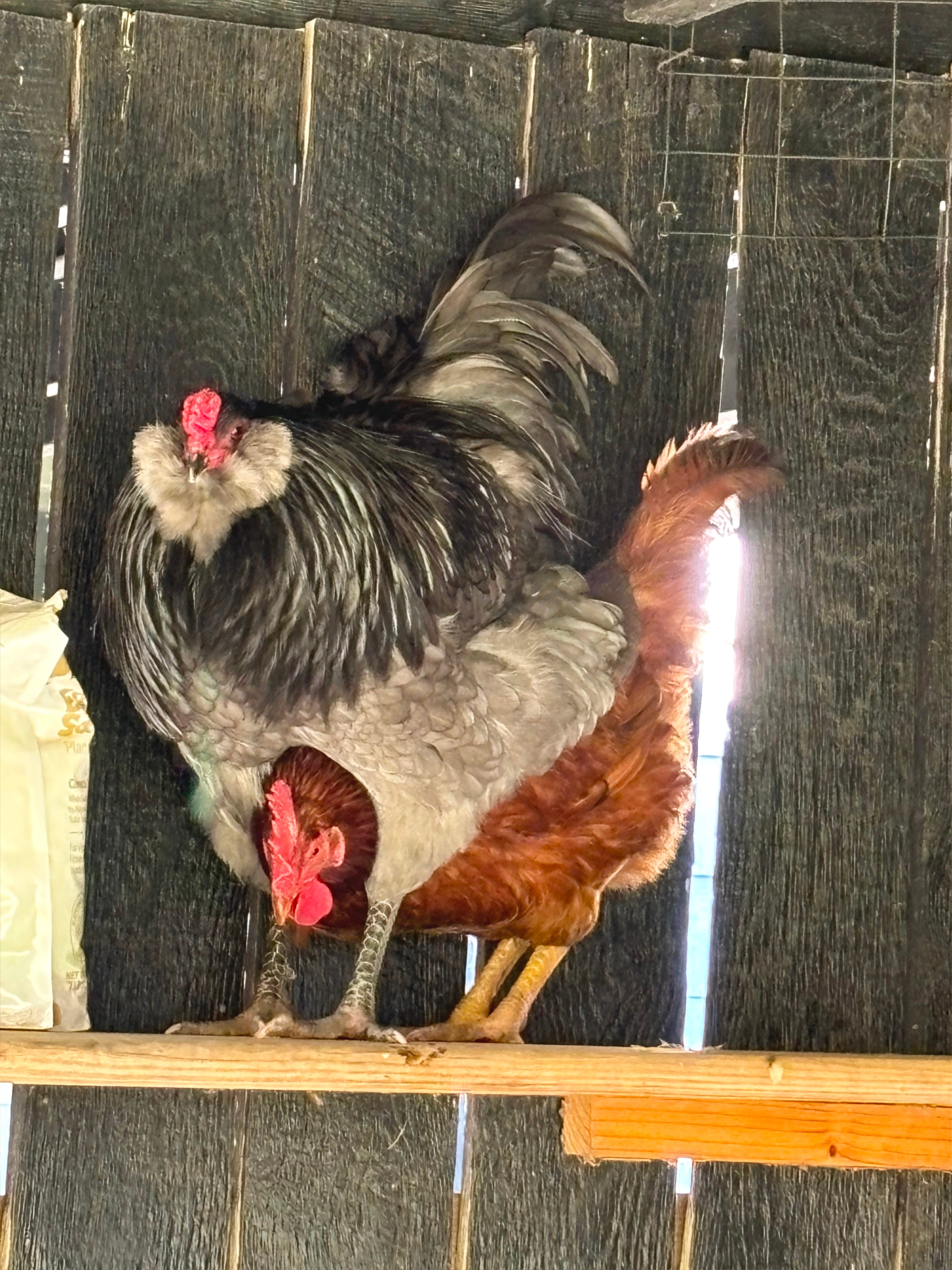
Samuel Whiskers and Lady Red
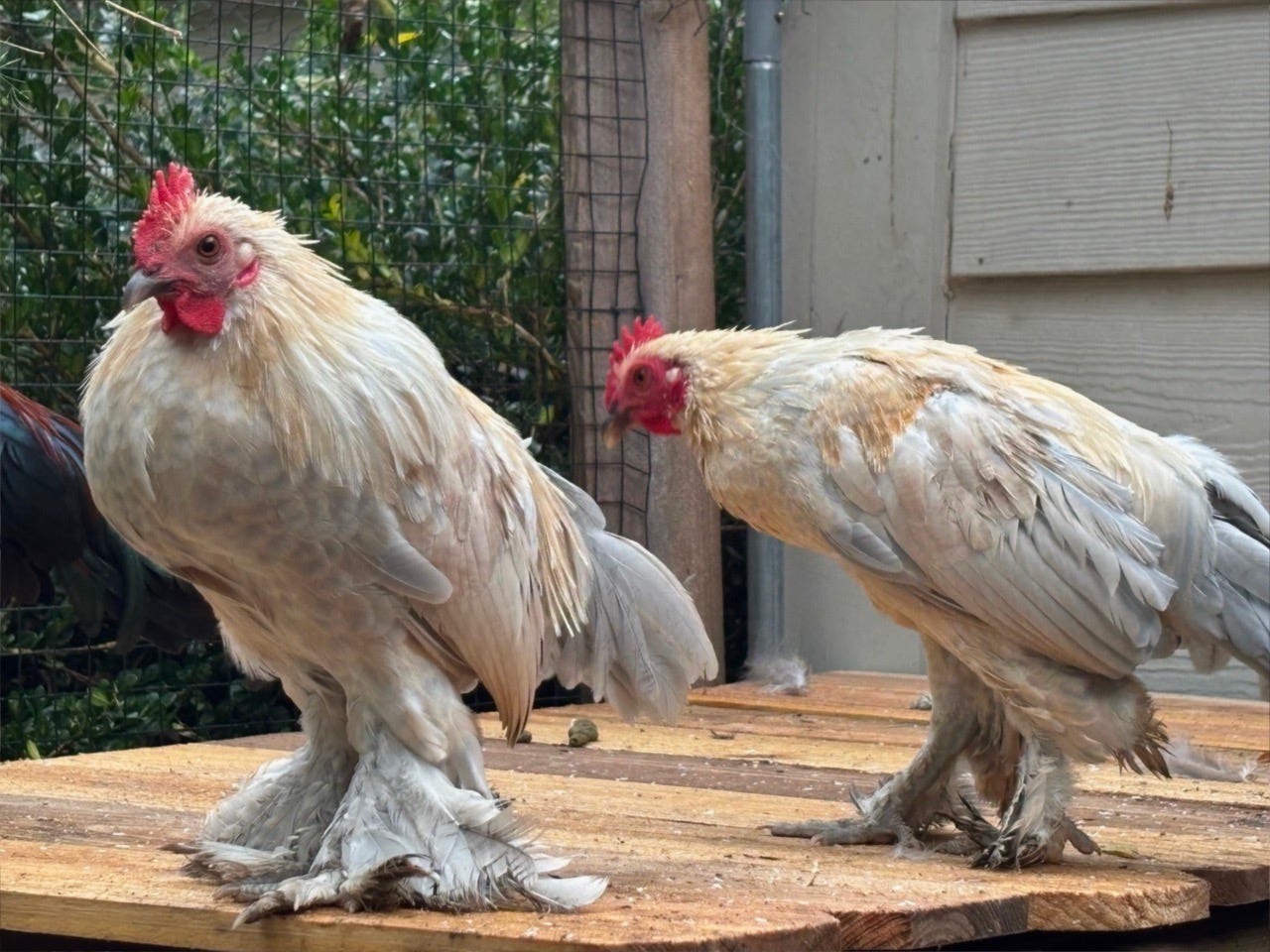
Benny and Björn: the bell-bottomed bantams (Porcelain d’Uccles)
[1] One seeming exception to this is the widespread anger in the US about Gaza, and the civilians killed, dispossessed and starved there since October 2023. But it is an exception that tends to prove the rule: Israel has a special place in the worldview of the US population, in part because of the Holocaust and the US’ determination that it should never happen again, in part because of the importance of a ‘strong Israel’ in the millennialist visions of Christian Zionists, in part because of the pro-Israel lobby’s brilliant use of US campaign financing laws to secure support for Israel, and in part, I think, because at some level many Americans see Israelis as pioneering ‘white’ settlers analogous to those who settled Native American lands in the 19th century. As US demographics have changed, and as global reportage and social media have made the protracted devastation accessible to the American public, the US government’s unquestioning support for Israeli belligerence has come to sit poorly with many Americans. Israel and Palestine have become, in a sense, a domestic political issue in the US, a ‘nearby’ question that is easier for us to care about.
[2] This is a less precarious process than you might think. Before they hatch, chicks absorb the remaining egg-yolk, and this gives them sufficient nutrition and hydration to last at least 48 hours, the period within which hatcheries plan their arrival. Chicks also keep one another warm in their ventilated boxes, which are handled quickly and carefully by the US Postal Service.
[3] Because stores that sell ‘straight-run’ (i.e. unsexed) chicks are often seeded with additional roosters. In part this is because chick sexing is difficult, but also because rooster chicks have no commercial value in the battery chicken world, and otherwise tend to be ground up in macerators. According to Ian Frazier, some six billion male chicks are killed this way every year.
[4] In Human Nature: A Walking History of the Himalayan Landscape, Thomas Bell makes this observation about Darwin: “Because of the subversive implications of making man into a beast, Darwin cultivated his views in private. He realized that human morality descends from the social and sexual instincts of animals, which, he wrote, are our brethren in pain, diseases, death, suffering and famine. He argued that shame, wonder, humour, reverence, curiosity, magnanimity, mutual love and sympathy are shared with lower species from our origin in one common ancestor. Moral behavior is not at odds with nature, but evolved from it. It’s a beautiful insight.”
[5] The Nuns Priest’s Tale is one of Geoffrey Chaucer’s 24 Canterbury Tales (1387-1400), and is a mock-heroic story of pride, cunning and come-uppance, full of Chaucer’s sly humour. This is how a priest, one of three chaperoning a nun on the pilgrimage to Canterbury, begins his tale—and suddenly remembers that he isn’t just speaking to his misogynist bros back in the monastery:
“My tale is of a Cok, as ye may heere,
That tok his conseil of his wyf, with sorwe,
To walken in the yerd upon that morwe
That he hadde met that dreem, that I yow tolde.
Wommennes conseils been ful ofte colde;
Wommannes conseil broghte us first to wo,
And made Adam fro Paradys to go,
Ther as he was ful myrie, and wel at ese.
But for I noot to whom it myght displese,
If I conseil of wommen wolde blame,
Passe over, for I seye it in my game.
Rede auctours, wher they trete of swich mateere,
And what they seyn of wommen ye may heere.
Thise been the cokkes wordes, and nat myne;
I kan noon harm of no womman divyne.“
[6] Jamsetjee Jeejeebhoy was a Bombay Parsee: his family descended from Zoroastrians who had fled the 7th century Islamic conquest of Iran, and had settled in India. At the age of 16 he made his first of many voyages to China, to trade Indian cotton and opium. In time he came to work closely with the Scottish drug merchants William Jardine and James Matheson, who in 1839 pressured the British Government to go to war with China in the name of free trade—free trade in narcotics, that was. Jamsetjee became immensely rich, and like other astute raptors (e.g. John D. Rockefeller, Cornelius Vanderbilt and Andrew Carnegie) hived part of his illicit fortunes into philanthropic causes, thereby acquiring social respectability to underpin his business success.
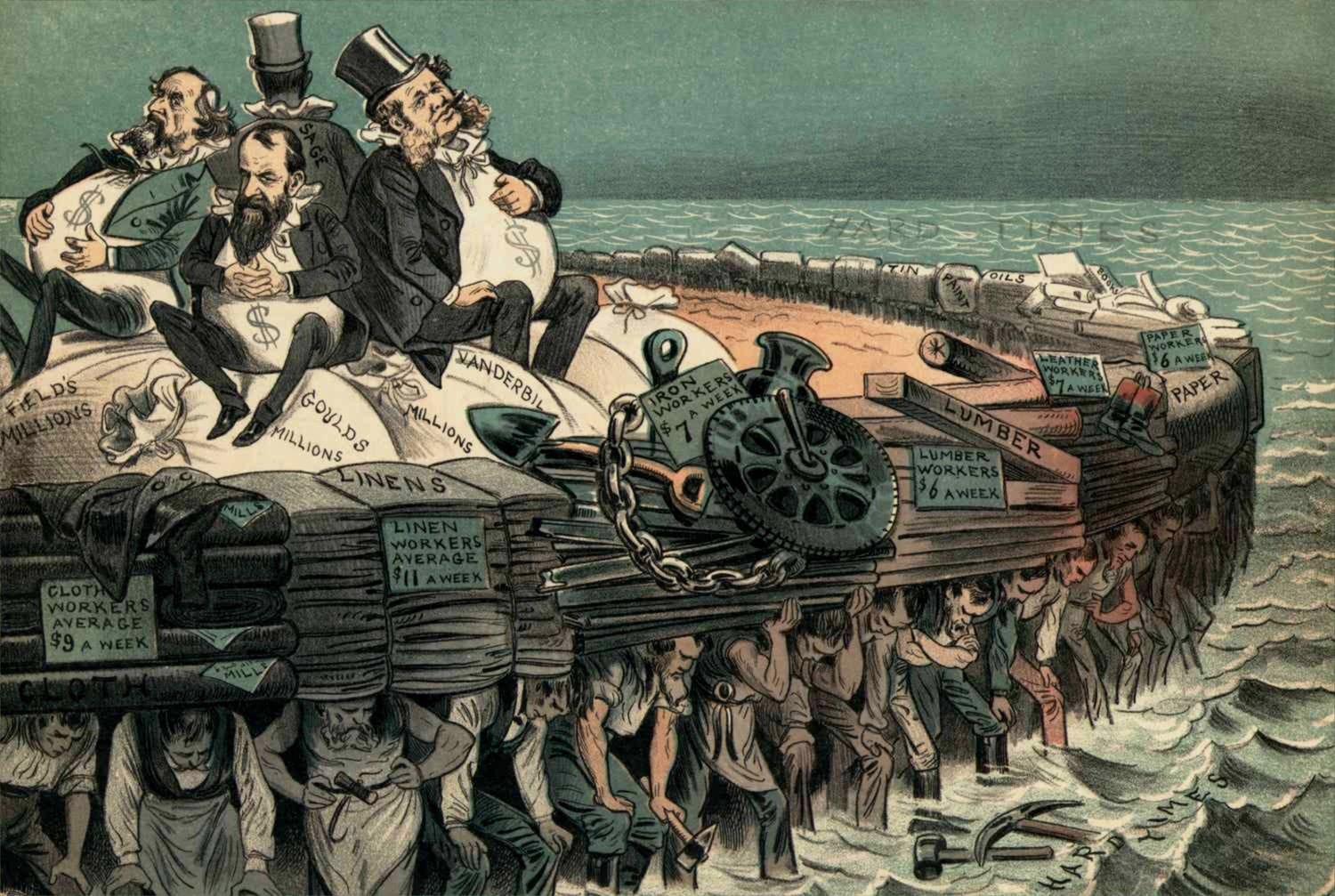
“The Protectors of our Industries”, 1883, depicting tycoons Cyrus Field, Jay Gould, Cornelius Vanderbilt II, and Russell Sage, in their money raft carried by oppressed workers. Everett Collection Inc.
Jamsetjee was knighted Sir Jamsetjee by Queen Victoria in 1842, and in 1857 was given a baronetcy (unlike a simple knighthood, a baronetcy is heritable). if we are disturbed by Donald Trump’s inconsistent drugs policy—seizing President Nicolas Maduro ostensibly for drug trafficking reasons while pardoning former Honduran president Juan Orlando Hernández, incarcerated in the US for cocaine dealing—it’s worth remembering Britain’s very own War On For Drugs, and that the first Indian knighthood and the first Indian baronetcy were awarded to a prominent opium pusher.
[7] The comparable numbers for cattle: a global herd of some 1.58 billion, with 305 million slaughtered each year—roughly 900,000 per day (the UN’s Food and Agriculture Organization, 2024).
[8] Frazier gives an example of this: In Brooklyn, Orthodox Jews slaughter chickens during Yom Kippur as part of the kapparot ritual: a bird is chosen for each family member, symbolically taking on that person’s past year’s sins, and is killed as atonement. Almost a hundred thousand broiler hens are sacrificed each year. Hundreds of sacks of dead chickens are put out with the trash.
I agree with all of this piece, from the quality of Chloe Dalton's thoughtful, insightful book, to the keeping of chickens as an act of resistance. Poppy Okotcha, gardener and author of 'A Wilder Way. How Gardens Grow Us', writes that growing things to eat—and she does keep chickens too, and lets them 'help' with keeping down hegemonous species—is an act of resistance, however small the plot and the crop.
I read this piece on the day I had just signed a petition with the campaigning organization Slingshot about the industrial raising of chickens, one of a number of campaigns over the last five years. We kept chickens for ten years, in rural Norfolk and then in Cambridge (UK). It was a really happy thing, our dogs and family loved them, the eggs were delicious and plentiful, their social relations fascinating. We didn't have rats, we only lost one to the fox (our fault) and we gave them decent burial when they died. I'd love to do it again. The only difference is that we no longer eat chicken, unless we are 100% certain it has had a happy, healthy life. The British welfare certifications—Red Tractor, RSPCA Assured etc. are worthless, the bar is set stupidly low.
I appreciate the comparative figures with beef. Increasingly, we just despair of being able to eat animal products at all without condoning cruelty. Females are exploited, males are discarded.
I loved the photo of you and Sir Jamsetjee on the sofa playing Sudoku. Now that really is resistance.